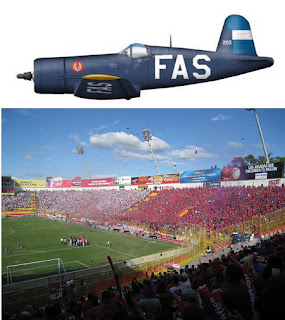
The Football War (La guerra del fútbol, in Spanish), also known as the 100-hours War, was a five-day war fought by El Salvador and Honduras in 1969. It was caused by political conflicts between Hondurans and Salvadorans, namely issues concerning immigration from El Salvador to Honduras. These existing tensions between the two countries coincided with the inflamed rioting during the second North American qualifying round for the 1970 FIFA World Cup; on 14 July 1969, the Salvadoran army launched an attack against Honduras. The Organization of American States negotiated a cease-fire which took effect on 20 July, with the Salvadoran troops withdrawn in early August. El Salvador ended up going to the 1970 FIFA World Cup1970 FIFA World Cup, where they failed to advance from the Group Stage.
Saturday, August 29, 2009
The Football War: started with a football game
 more
more
Emu War: how Australia lost a war against birds

The Emu War, also known as The Great Emu War, was a week-long military operation undertaken in Australia in November 1932 to address public concern over the number of emus said to be running amuck in the Campion district of Western Australia. The emus were responding to a long, hot summer, which caused shortages of food and water. The "war" was conducted under the command of Major Meredith of the Royal Australian Artillery, commanding a force of soldiers armed with two Lewis machine guns and 10,000 rounds of ammunition. But shooting blindly into a group of birds which can run up to 50 km/h (30 mph) did not brought the expected results. The birds simply ran away even after being hit by a machine gun round.
Over the course of a week or so, only a handful of the estimated 20,000 birds were actually killed. Major Meredith - the Australian commander in the "Emu war" - was astonished and famously compared the emus to Zulus. After a few days the Defence Minister ordered a withdrawal. And thus the "Emu War" ended in a military defeat for Australia.
Three Hundred and Thirty Five Years' War

The Three Hundred and Thirty Five Years' War (1651–1986) was a war between the Netherlands and the Isles of Scilly (located off the southwest coast of the United Kingdom). It is said to have been extended by the lack of a peace treaty for 335 years without a single shot being fired, which would make it one of the world's longest wars and the war with the fewest casualties. Despite the uncertain validity of the declaration of war, peace was finally declared in 1986.
The Pig War: triggered by the shooting of a pig

The Pig War was a confrontation in 1859 between American and British authorities over the boundary between the United States and British North America. The specific area in dispute was the San Juan Islands, which lie between Vancouver Island and the North American mainland. The Pig War, so called because it was triggered by the shooting of a pig, is also called the Pig Episode, the Pig and Potato War, the San Juan Boundary Dispute or the Northwestern Boundary Dispute. The pig was the only "casualty" of the war, making the conflict essentially bloodless.
The Anglo-Zanzibar War: the shortest war in history, only 40 minutes long

Fought between the United Kingdom and Zanzibar on 27 August 1896, the conflict lasted approximately 40 minutes, making it the shortest war in history. The immediate cause of the war was the death of the pro-British Sultan Hamad bin Thuwaini and the subsequent succession of Sultan Khalid bin Barghash. The British authorities preferred Hamud bin Muhammed as Sultan. In accordance with a treaty signed in 1886, a condition for accession to the sultancy was that the candidate obtain the permission of the British Consul, and Khalid had not fulfilled this requirement. The British considered this a casus belli and sent an ultimatum to Khalid demanding that he order his forces to stand down and leave the palace. In response, Khalid called up his palace guard and barricaded himself inside the palace.
The ultimatum expired at 09:00 on 27 August, by which time the British had gathered three cruisers, two gunships, 150 marines and sailors and 900 Zanzibaris in the harbour area. A bombardment which was opened at 09:02 set the palace on fire and disabled the defending artillery. The flag at the palace was shot down and fire ceased at 09:40. The Sultan's forces sustained roughly 500 casualties, while only one British sailor was injured.
Sega Robot Cat

This is “Yume-Neko Venus,” or “Dream Cat Venus.” This Japanese toy is equipped with touch sensors that let it engage in such real-life feline behavior as purring, moving its legs when you rub its belly, and sleeping a lot. It could be cute if it weren't so damn creepy. (Link)
Japanese Shaving Baby

OK, this one definitely tops the list for the most disturbing toy of all times! The super hairy ‘Shave the Baby' doll was created with added bushy tufts of bright orange hair protruding from her ankles, armpits, and most disturbingly, her pubic region, and was designed with the intention of giving the owner of the doll the pleasure of shaving it off.
For most of us — shaving ourselves is hassle enough, why would we want to do it to a doll as well? Um, don't answer that. (Link)
H-Bouya Erotic USB Toy

Here's the weirdest toy, designed by Cube in Japan: the H-Bouya! The 'H' used in the name may also mean ‘erotic' in Japanese ('H' is pronounced “eechi” = erotic). So you can say this is the Erotic Boy! H-bouya is plugged into a USB port, and each time the keyboard's ‘H' key is hit, it turns red and its eyes blink! (Link)
Japanese Popping Edamame Keychain

Edamame are baby soybeans, picked before they blossom into adulthood, and boiled. Edamame are also delicious and fun to pop out of their pods. But say you want the fun of popping edamame, but you're not very hungry. Oh, then we have the keychain for you! Each Japanese Popping Edamame Keychain has three beans. The end beans are small and immature. The middle beans, however, have one of 12 random faces printed on them. Why? We don't know, but there is nothing like the smile they put on your face. And the beans are connected to some sort of elastic band, so they pop back in to be popped out again as many times as you want. It sounds silly, but trust us, these things are highly addictive. They are also a great way to keep your fingers busy during boring meetings and your mood positive - because no one can frown when the edamame smiles. (Link)
Tuttuki Bako Poking Box

This new interactive toy from Japan involves sticking your finger in a hole on the side of the box to interact with a virtual environment.
Found at Geek Stuff 4 U for a little bit over $48.
(Link)
Strange Japanese Pregnant Doll

In the 18th and 19th centuries, sideshow carnivals known as misemono were a popular form of entertainment for the sophisticated residents of Edo (present-day Tokyo). The sideshows featured a myriad of educational and entertaining attractions designed to evoke a sense of wonder and to satisfy a deep curiosity for the mysteries of life. One popular attraction was the pregnant doll.
Although it is commonly believed that these dolls were created primarily to teach midwives how to deliver babies, evidence suggests they were also used for entertaining purposes. (Link)
Monday, December 15, 2008
Strange Animals From Japanese Museum
What do you think about weird animals which you may see in Japanese museum. Maybe you will recognize some of them but for some I really don’t know which are. They have very strange look, something what you are not going to see very often.


Copyright © 2009
.



